Last week I read an article in the NY Times about cold-brew coffee and decided to try it.
I'm drinking a cup now.
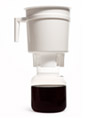
How it works. You buy a special plastic brewing container, it holds about a half gallon of water and one pound of coffee. There's a hole at the bottom of the container, which takes a plug, and has a place to lay a filter which is about 1/2 inch thick, made of some kind of fiber. You let the whole thing stand for 3 or 12 hours (depending on whose instructions you're following) and then pull the plug and put the plastic container on top of a carafe designed to fit under it. Let it drip for about 1/2 hour and then put the carafe in the fridge. The next morning it's cold and ready to make into iced coffee, or to be diluted (it creates a concentrated coffee) and zapped in a microwave.
It's supposed to create radically better coffee.
As I said, I'm drinking a cup now, and it doesn't taste any different from hot-brewed coffee. I'll try some iced coffee later, but I'm not expecting radically greater coffee.
BTW, the Times article reads like a blog post.
Just thought I'd mention that. ";->"
Last update: Thursday, June 3, 2010; 4:01:12 PM
~About the Author~
Dave Winer, 55, is a visiting scholar at NYU's Arthur L. Carter Journalism Institute. He pioneered the development of weblogs, syndication (RSS), podcasting, outlining, and web content management software; former contributing editor at Wired Magazine, research fellow at Harvard Law School, entrepreneur, and investor in web media companies. A native New Yorker, he received a Master's in Computer Science from the University of Wisconsin, a Bachelor's in Mathematics from Tulane University and currently lives in New York City.
"RSS was born in 1997 out of the confluence of Dave Winer's 'Really Simple Syndication' technology, used to push out blog updates, and Netscape's 'Rich Site Summary', which allowed users to create custom Netscape home pages with regularly updated data flows." - Tim O'Reilly.

 How it works. You buy a special plastic brewing container, it holds about a half gallon of water and one pound of coffee. There's a hole at the bottom of the container, which takes a plug, and has a place to lay a filter which is about 1/2 inch thick, made of some kind of fiber. You let the whole thing stand for 3 or 12 hours (depending on whose instructions you're following) and then pull the plug and put the plastic container on top of a carafe designed to fit under it. Let it drip for about 1/2 hour and then put the carafe in the fridge. The next morning it's cold and ready to make into iced coffee, or to be diluted (it creates a concentrated coffee) and zapped in a microwave.

 scriptingnews1mail at gmail dot com.