|
||||||||||||||||||||||||||||||||||||||||||||||||||||
|
What Twitter is
I've been reading various posts and comments, and see a thread that's still out there. People doubt that there's a way to make money with Twitter. To that I say, they haven't been reading this blog.
 1. It's a network of users, with one kind of relationship: following. I can follow you, and you can follow me. Or I can follow you and you don't follow me. Or you can follow me, and I don't follow you. Or neither of us follow each other. Pretty simple. Just arrows at either or both ends of the line, or no line at all. There are no labels on the arcs.
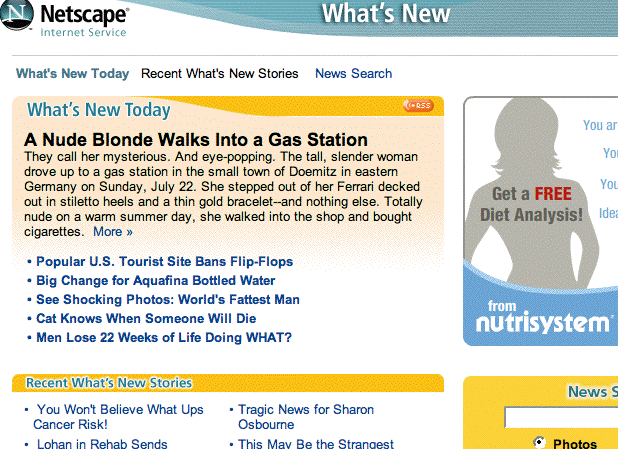
2. It's a micro-blogging system. Posts are limited to 140 characters. Enough for a bit of text and a link. This is a powerful idea, but not a new one. If you read Scripting News before February of this year, it was partially a micro-blogging system. When it started in April 1997, it was all micro-blogging. The earliest websites, from TBL, NCSA and Netscape were also micro-blogging systems.
An aside, I gave a talk on Sunday at the WordPress users conference. One of the things we talked about was micro-blogging. I asked the people if they would like it if the only way you could create a WordPress site was on wordpress.com. They agreed that would not be good. Analogously, if micro-blogging is to become a real art, there will have to be many ways to create a micro-blog, and lots of RSS to tie them together.
 3. A relatively open identity system. I've said it before, Twitter or something like it, could be the holy grail of open identity. While the engineers of the tech industry have been, imho, looking at the problem the wrong way by trying to glue together the huge namespaces controlled by powerful companies who don't want to give up control. Twitter, with it's ultra-thin user interface, and light feature set, and simple API (more on that in a bit) and the nothing-to-lose attitude of its management, may be the breakthrough. Or it could be Facebook, with it's much larger user base and a management that also likes to roll the dice. The key is lots of users, a growing user base, and an API with no dead-ends. 3. A relatively open identity system. I've said it before, Twitter or something like it, could be the holy grail of open identity. While the engineers of the tech industry have been, imho, looking at the problem the wrong way by trying to glue together the huge namespaces controlled by powerful companies who don't want to give up control. Twitter, with it's ultra-thin user interface, and light feature set, and simple API (more on that in a bit) and the nothing-to-lose attitude of its management, may be the breakthrough. Or it could be Facebook, with it's much larger user base and a management that also likes to roll the dice. The key is lots of users, a growing user base, and an API with no dead-ends. 4. An ecosystem. Twitter's API is very simple. It covers the entire functionality, leaves nothing out. You could implement the Twitter user interface using the API. That's a key thing. Compare it to Apple, who reserves for itself and a few partners, under terms we don't know, the right to develop rich apps for the iPhone. Twitter takes the traditional PC industry approach, give everyone equal power, make it a level playing field and let the chips fall where they may. This means that if the people at Twitter miss an opportunity, the rest of us have a shot at providing it for ourselves and others.
 So what do all these parts add up to? Users and relationships between users, their ideas, and an ecosystem. It's probably the basis for some pretty hot apps. Will it be possible to monetize them? Without a doubt. People who say that Twitter hasn't figured out how to make money don't understand the role technology companies play in the much larger media and communication ecosystem. Ideas gestate here, grow up, find users, and then find customers. In a way Twitter is a mega-enterprise product, and by using it, we're helping them prove it. Their customer is likely to be a telco or an entertainment network. But it's way too early to cash it out, they all took the right approach, seed it with some more capital to add more bandwidth, solidify the back-end, add a bit more functionality, and wait to see what the users and developers do with it. So what do all these parts add up to? Users and relationships between users, their ideas, and an ecosystem. It's probably the basis for some pretty hot apps. Will it be possible to monetize them? Without a doubt. People who say that Twitter hasn't figured out how to make money don't understand the role technology companies play in the much larger media and communication ecosystem. Ideas gestate here, grow up, find users, and then find customers. In a way Twitter is a mega-enterprise product, and by using it, we're helping them prove it. Their customer is likely to be a telco or an entertainment network. But it's way too early to cash it out, they all took the right approach, seed it with some more capital to add more bandwidth, solidify the back-end, add a bit more functionality, and wait to see what the users and developers do with it. Twitter is still a very interesting service, and as long as it remains as open as it is, we can all learn from and alongside them.
Harold Gilchrist: "Some actually see that Web/SMS Gateway as a key component of their architecture."
|
Last update: Thursday, June 3, 2010; 4:01:18 PM
Mail:
|
|||||||||||||||||||||||||||||||||||||||||||||||||||
|
© Copyright 1997-2010 Dave Winer. Last build: 6/3/10; 10:40:46 PM. "It's even worse than it appears." Previous / Next |
||||||||||||||||||||||||||||||||||||||||||||||||||||
 Congrats to the lead investors,
 scriptingnews1mail at gmail dot com.