|
|||||||||||||||||||||||||||||||||||||||||||||||||||||||||||
|
The year of the social network
 As long as I've been involved in the tech industry there's been the concept of The Year of X, where X has been artificial intelligence, personal information managers, local area networks, CD-ROMs, P2P. Proclaimed by tech pubs, most likely to help their ad sales reps sell space, they focused the attention on areas the industry was investing money, in hopes of being there when lightning strikes, when wealth is created, as it often is in the tech industry. Sometimes the "year of" prognostications are right, more often they're wrong. As long as I've been involved in the tech industry there's been the concept of The Year of X, where X has been artificial intelligence, personal information managers, local area networks, CD-ROMs, P2P. Proclaimed by tech pubs, most likely to help their ad sales reps sell space, they focused the attention on areas the industry was investing money, in hopes of being there when lightning strikes, when wealth is created, as it often is in the tech industry. Sometimes the "year of" prognostications are right, more often they're wrong.  In that sense, there's no doubt that 2007 is the year of the social network in Silicon Valley. This may not be the year when huge wealth is created, but I don't doubt that the area is fertile, and I don't say that lightly, because I'm often a contrarian when it comes to self-induced Silicon Valley euphoria.
There are a couple of ideas I've been getting ready to write about, I'm not quite ready yet, but here they are anyway.
1. When people get together to discuss Twitter, and perhaps other social networks (and Twitter is that, a bare-bones social network), they often discuss as if there were a common user experience, but this is a misperception, there are many different experiences, they may group into large subsets of the users, and they may not. Some food for thought.
On Twitter I try to keep a ten percent ratio of people I follow over people who follow me. For other people, maybe most, the ratio is 1-to-1, they follow approximately the same number of people as follow them. Scoble follows thousands of people. For him Twitter is like a very fast chatroom. For me it's like weblogs.com on a busy day in 2002. I've seen people who follow 0 people, for them Twitter is a publishing environment. Very different experiences. To each of them Twitter is a different product.
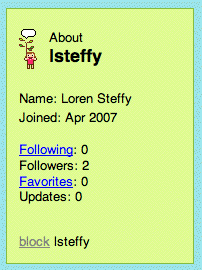
 Note that when reporters cover Twitter, before they've become users, they probably write about the home page at Twitter, where complete strangers report on the kind of spaghetti sauce they like. That may be why so many articles dismiss Twitter as useless. (Dwight Silverman, a columnist at the Houston Chronicle, provides the evidence. "When my colleague Loren Steffy trashed [Twitter], for example, he did so without ever adding anyone to his Twitter page." In fact, Steffy is following 0 people, is followed by 2, and has updated 0 times.) Note that when reporters cover Twitter, before they've become users, they probably write about the home page at Twitter, where complete strangers report on the kind of spaghetti sauce they like. That may be why so many articles dismiss Twitter as useless. (Dwight Silverman, a columnist at the Houston Chronicle, provides the evidence. "When my colleague Loren Steffy trashed [Twitter], for example, he did so without ever adding anyone to his Twitter page." In fact, Steffy is following 0 people, is followed by 2, and has updated 0 times.) 2. Integration is so tempting, but elusive. The other day a friend on Twitter wrote about a movie he liked. I looked it up on the NY Times movie review site (a newly revealed location now that their archive is open and a very valuable one, another topic I plan to cover, the wealth of the NY Times archive). I would have then liked to have clicked over to Netflix to order it. And even better, I'd have liked to have looked at what other movies he likes.
Now we're very close to having this, we just need a way to co-relate two identity systems, Twitter's and Netflix's. And think of the value in integrating Amazon with Twitter. The mind explodes at the possibilities. This is what I meant when I said earlier "theyÕre not trivial problems, theyÕve been there since the Internet outgrew academia and started being used for commercial purposes."
This issue is now coming to a head, as the users can see the next step clearly. How to integrate the systems is known technology, but it's not a solved problem economically and politically. We need to get clear on the opportunities, and feel free to dream when the barriers between the networks come down.
|
Last update: Thursday, June 3, 2010; 4:01:37 PM
Mail:
|
||||||||||||||||||||||||||||||||||||||||||||||||||||||||||
|
© Copyright 1997-2010 Dave Winer. Last build: 6/4/10; 7:36:26 AM. "It's even worse than it appears." Previous / Next |
|||||||||||||||||||||||||||||||||||||||||||||||||||||||||||

 scriptingnews1mail at gmail dot com.