
|
||||||||||||||||||||||||||||||||||||||||||||||||||||
|
USB-DACs
 A USB-DAC connects through the USB port to a Mac or PC, and to an amplifier and speakers. Apparently you can get much higher quality sound from your computer, for as little as $200 with the Stereo-Link 1200. I didn't know these products existed until I heard a report on the Tech Talk podcast, and read the article in today's NYT. A USB-DAC connects through the USB port to a Mac or PC, and to an amplifier and speakers. Apparently you can get much higher quality sound from your computer, for as little as $200 with the Stereo-Link 1200. I didn't know these products existed until I heard a report on the Tech Talk podcast, and read the article in today's NYT.   Update from Kevin Newman: "If your audio receiver has optical digital inputs, and your computer has optical digital audio output, connecting them digitally allows the receiver to do the D-to-A conversion. If you have an expensive receiver, it already has nice converters. That would almost certainly sound better than taking the analog minijack output from your computer. I'm not sure how the sound would compare to one of the external DACs listed in the article, but a digital connection is less clutter and less expensive." Update from Kevin Newman: "If your audio receiver has optical digital inputs, and your computer has optical digital audio output, connecting them digitally allows the receiver to do the D-to-A conversion. If you have an expensive receiver, it already has nice converters. That would almost certainly sound better than taking the analog minijack output from your computer. I'm not sure how the sound would compare to one of the external DACs listed in the article, but a digital connection is less clutter and less expensive." 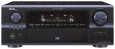 Postscript: Newman was right. I have a good Denon receiver (the one with the integrated HTTP server) that has several optical inputs on the back, and when I replaced the analog cable connecting the Mac Mini to the receiver with a digital cable, the increase in quality was incredible. There are physical sensations to recorded music that I had never experienced before. I have some flac recordings and I ran those through the new setup and was blown away. Postscript: Newman was right. I have a good Denon receiver (the one with the integrated HTTP server) that has several optical inputs on the back, and when I replaced the analog cable connecting the Mac Mini to the receiver with a digital cable, the increase in quality was incredible. There are physical sensations to recorded music that I had never experienced before. I have some flac recordings and I ran those through the new setup and was blown away. Illustration: The important thing about the back panel is that there are four optical (digital) inputs, which are compatible with the digital output of the Mac. So when you play an MP3 from the Mac, and connect to the receiver with the optical cable, the D-to-A conversion is done by the receiver. The Mac is $500 of computer hardware (and damn good at what it does) and the Denon is $2K of audio hardware, and also very good. This setup lets each system do what it does best. The result is stunning sound. Really hard to explain how good it is.
|
Last update: Thursday, June 3, 2010; 4:01:56 PM
Mail:
|
|||||||||||||||||||||||||||||||||||||||||||||||||||
|
© Copyright 1997-2010 Dave Winer. Last build: 6/4/10; 7:40:30 AM. "It's even worse than it appears." Previous / Next |
||||||||||||||||||||||||||||||||||||||||||||||||||||

 scriptingnews1mail at gmail dot com.