There's an informal mail list started
by Karl Martino, with various people from the Philadelphia Daily News,
Knight-Ridder pubs, various A-list bloggers, editorial people from
other news organizations. The topic is the upheaval happening in
Knight-Ridder papers, and since Karl is from Philadelphia, a blogger,
and an ex-Philly.com tech guy, the focus is on Philadelphia. Yesterday
came news that one of the investment bankers working for K-R has
suggested that no matter what the Daily News will shut down. Whether or
not this is true, it has sparked a heated discussion. This is my
contribution, pulled out of context, admittedly, but the context sure
ain't pretty. This follows the grain of my How to Make Money pieces,
written in 2001 and 2000, and assumes that what will replace the Daily
News is some hybrid of what exists today and citizen journalism. Here's
the post.
Here's what you can do right now:
1. Use the newspaper that
still exists to inform the community that it's fairly likely that the
newspaper is about to go out of existence.
2. Ask leaders from
the community to let you know what *they* want to do about it. If they
want to start writing for the newspaper, covering local events, school
board meetings, high school sports events, whatever. Don't ask them for
money, let them think of that (it's pretty obvious you need money,
right?)
3. Start running their pieces right now, in the print paper.
4. Give them editorial space on the op-ed page (if you have one) and on
the main editorial page as well. Let them not just report on the events
of the day, but offer a perspective on the events.
In other
words start the transition now from professional to community
editorial, while you still have the resources of a print daily.
And this isn't just about you -- it's about your community.
Imagine a different circumstance. You're in an airport, your flight has
been cancelled because the airline is laying off staff, and doesn't
have enough personnel to run the airline as-is. All the person behind
the counter can think of is whether or not they will get to keep their
job. As a member of their community this is pretty disturbing, because
what YOU care about is getting from point A to point B, safely. You're
in a strange city and you want to get home. But they're not thikning
about that, they're just thinking about their job. Is it
understandable? Sure. Is it acceptable? No!
Now these steps
also have the best chance of saving your job, because if you can show
that you can turn over reporting to the community and reduce staff to
editorial and administrative functions, you might just be able to find
a profitable business in there.
Good luck, and we'll be watching with interest.
Dave
# Posted by Dave Winer on 12/1/05; 2:34:40 PM - --
Later today I'll give a keynote address, at a BBQ.
That's got to be a first.
It's a tradition that when I give a talk, I prepare it on Scripting News, in the open, for all to see.
Since this talk will be given in the heart of Silicon Valley, it seems
reasonable to talk about the heart of Silicon Valley. What happened to
it? Did it ever exist? Was it swamped by arrogance? Did it come back
only to be lost again?
And what of The Long Tail. Where is the Big Head? And the Big Ego?
Is Web 2.0 totally 1.0? (Ref Microserfs.)
Check it out, all the Web 2.0 companies are building on a 20th century
model, intrusive advertising. Do any of them see the opportunity with
commercial information people actually want?
And what of the change in century? Isn't it interesting that between
the supposed 1.0 (pet food companies doing high tech IPOs) and 2.0
(build to flip the Flickr of evrything) we changed millennia? Are we
still creating monocultures?
These are all things to think about. One final thing.
Can Silicon Valley laugh at itself?
Perhaps when it can, it can be said to have a future. 
# Posted by Dave Winer on 10/21/05; 9:17:13 AM - --
I was over at Mike Arrington's house today and he told me about a loose affiliation of sites that cover the new thing that we call the Web 2.0, or I've always called The Two-Way Web. Mike asked if I wanted to include this site, and I said of course, let's give it a try.
# Posted by Dave Winer on 10/12/05; 8:38:56 PM - --
Okay I've spent some time with Yahoo's news search and sent a note to Scott Gatz requesting a bit of advance notice next time, so we can review these things before they roll out.
There's a lot to like about their approach, but it is still not good enough to take the place of Google for news-oriented searches, even though Google explicitly excludes blogs from their search. And that's the game, you have to be so much more current and so much more useful than Google that there are times you click on their icon and not Google's (and they don't even have an icon in my toolbar yet).
Therefore, some comments...
1. Blogs don't belong in the margin, they belong in the main results. There's so much confusion about what is and isn't a blog, why bother even trying to make a distinction. BusinessWeek has a blog, but it's not the same thing as Scripting News, right? Or is it? Where should BW's blog be? Why should it be in a different place from their editorial stuff? Don't expect the line to get more solid in the future, it's going the other way, getting more blurry all the time.
2. It's not totally clear if the Advanced Search options apply to blogs, or just the MSM sites.
3. Are they using RSS for the blog search or is it done by scraping HTML?
4. It's great that they allow results to be sorted by date. This is a feature I've wanted in Google for ages. Maybe they've always had it in Yahoo? Not sure, I never use it.
5. And they have to stop being so particular about who they talk to, if they want to gain ground on Google which totally has a commanding lead in search. We want Yahoo and other search competitors to be in the game, because competitive situations are good for users, but you have to work with us if you want our help.
PS: That last bit of advice goes in spades to MSN.
# Posted by Dave Winer on 10/11/05; 10:28:45 AM - --
There are so many stories that connect together in this one development, I'm going to have to do a podcast to explain (and I will, tomorrow), but in the meantime I wanted to show a rough top-level of the project, and give a brief idea of where it goes.
First, look at any archive page on Scripting News, for example the page for today.
http://archive.scripting.com/2005/09/28
If you look in the right margin, you'll see a box that lists the top level of an OPML directory being edited by Mike Arrington over at TechCrunch. Each of the items in the directory is an article on TechCrunch. I wanted to include his content in mine because I would point to every review he writes, they're all on-topic for Scripting News readers.
When he makes a change to that directory, the box recalcs. When it appears on www.scripting.com tomorrow, it will recalc every time I update Scripting News (that page is statically rendered). If you want you can include Mike's directory in your site, or in your directory through inclusion. It's a normal OPML file, edited with the OPML Editor.
This is, in so many ways, the kind of collaboration I envisioned when I released the OPML Editor. Mike, a lawyer who loves technology, is exactly the kind of person I want to empower with OPML.
# Posted by Dave Winer on 9/29/05; 1:55:14 AM - --
Michael Watkins
The terrible events we have witnessed in New Orleans are just the latest in a series of failures by our government to prevent predictable surprises. In crises ranging from the lax oversight of public companies that led to Enron, the systemic weaknesses in airline security and intelligence gathering that presaged 9/11, the dismal post-war planning in Iraq, and now the catastrophic damage wrought by Katrina on the Gulf Coast, our leaders have failed to mobilize to avoid well-recognized potential disasters. The resulting crises were surprising to the public; to the experts who saw them coming and sought in vain to get our leaders to pay attention, they were completely predictable.
There is an understandable but dangerous tendency at times like these to focus on the immediate crisis, first weathering it, then diagnosing why it happened, and finally distilling out lessons-learned. This is dangerous because our problems in New Orleans are just a symptom of a much deeper malaise, and the public should have no confidence that we have reached the end of this losing streak (more on this later). It therefore is essential that we focus on the pattern of failure, and not the individual instances. Our leaders can't be permitted to deal with these disasters as if they are not part of a pervasive and damaging pattern. If we don't look on the bigger picture, we will continue to "fight the last war."
Why have we become vulnerable to being predictably surprised? What are the root-causes of our increasing vulnerability? It boils down to ideology, institutions, and interests. Ideology is the triumph of belief over available evidence. This is fine in realm of faith; but when ideology guides public policy, these victories often are pyrrhic. In the long run reality bites. In the interim, ideological beliefs – about dealing with the degradation of coastal wetlands, or the roots of Islamic terrorism, or the regulation of public companies, or the security of the nation’s airlines – can hold sway for long enough to do a lot of damage, skewing priorities and weakening institutions. Ideology permits leaders to exist in a state of denial until (and sometimes even after) the walls come tumbling down. Too often our leaders cry out in the aftermath of disasters that they “didn’t know,” when in truth they didn’t want to know, because knowing would create uncomfortable dissonance with their closely held beliefs.
Public institutions are key sinews that knit our society together and their decline – through loss of capacity, watering down of mandates, and weakening of leadership – are sure leading indicators of predictable surprises. In the aftermath of 9/11, for example, did anyone doubt that our country needed strong institutions to deal with crisis management and disaster relief? So how is it possible, four years later, that FEMA’s response to Katrina was so terribly ineffectual? Much attention has been focused on the subordination of that agency and its priorities to the new Department of Homeland Security and its terrorism mandate. But the real crippling of the agency happened during ritual decapitation of our government that occurs at the beginning of each new Presidency. Experienced crisis managers were replaced by loyal political appointees who lacked, to put it charitably, the capacity to do the job, and their presence triggered a broader exodus of crisis management expertise. If this happened in FEMA, what confidence should we have in our other critical institutions?
Finally special interests fuel the systematic misallocation of resources that lies at the root of many predictable surprises. Were experts pressing for more funding to be devoted to shoring up the levees protecting New Orleans before Katrina, to enhancing SEC oversight of public companies pre-Enron, to strengthening aviation security given the four GAO prior to 9/11, and to sending more troops to control Iraq? The answer in every case was yes. Yet in every case special interests flexed their muscles to challenge expert assessments and distort funding priorities in order to protect their perquisites and favor their constituencies, hobbling efforts to prevent predictable surprises. Even in Louisiana, where politicians were best positioned to understand the risks, available flood control funding was channeled to projects of negligible value.
In the predictable aftermath of the disaster in New Orleans, the public can expect our leaders to commission commissions and initiate initiatives. But absent a concerted effort to deal with the deeper issues – to move beyond ideology to confront reality, to strive for middle-ground consensus about the critical roles of government in our society, to assess and strengthen all our critical institutions and not just focus on the latest failure, and to curb the power of special interests to dilute preventative measures and distort funding priorities – we should expect to continue to be predictably, predictably surprised.
This summer, the author surveyed participants in a program for national security officials held at the Kennedy School of Government, asking them to identify the most damaging predictable surprises that could strike the United States before 2010 and to assess their likelihood. Forty percent of participants (the largest single block) indicated that there was a better than 50% probability that terrorists would successfully launch an attack using weapons of mass destruction on a U.S. city in the next five years. They were fully aware of the enormity of the resulting economic and social consequences. But they openly acknowledged that nothing close to appropriate levels of resources were being allocated to deal with the threat, a harbinger of a future predictable surprise.
Michael Watkins is the founder of Genesis Advisers, a leadership strategy consultancy and was formerly on the faculty of Harvard’s Kennedy School of Government and Business School. He is the co-author, with Max Bazerman, of Predictable Surprises: The Disasters You Should Have Seen Coming and How to Avoid Them (HBS Press, 2004).
# Posted by Dave Winer on 9/21/05; 12:21:08 PM - --
After Gnomedex in June, I flew down from Seattle to meet with Ethan Diamond in San Francisco. Ethan is a smart young developer working for Yahoo on their new browser-based mail application. I first met him a couple of years ago when he was working on the same mail app at Oddpost, a San Francisco-based startup that he co-founded. Before that he worked at Half.com, where he developed an astounding browser-based spreadsheet that was demoed on a web apps panel I led at Esther Dyson's conference in Y2K in Phoenix.
Ethan and his partners were pioneers in what's now come to be known as the AJAX method of browser-based apps. There's some very cool technology underneath their user interface, but the net-effect is that their apps look and behave like graphic-based apps, but they run in a browser. Ease of use of desktop apps, with the convenience and portability of browser-based software
In June I got the demo, saw what I expected to see, a deeper and more polished version of the app that Oddpost developed, but running inside Yahoo. It's their new user interface for mail, and it's very nice. Soon it will be offered to all Yahoo users, and at some point it will probably become the default user interface for mail on Yahoo.
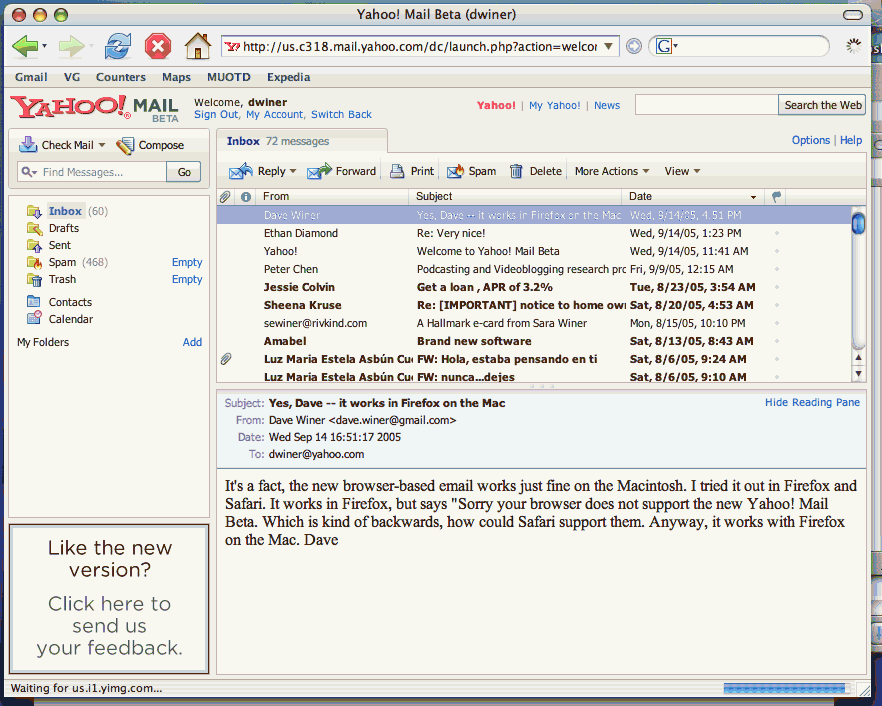
Today my account was turned on -- here's what it looks like. It works exactly like you'd expect. The scroll bars work, which is a big improvement over other browser-based email apps that divide your mailboxes into pages. In Yahoo, you don't have to wait while it loads the next page. It seems to be loading the next page in the background, while you're scrolling through the previous page.
Here's a screen shot of the window for composing email.
My mail address is dwiner at yahoo dot com. Send me a question and I'll see if I can answer it. So far so good!
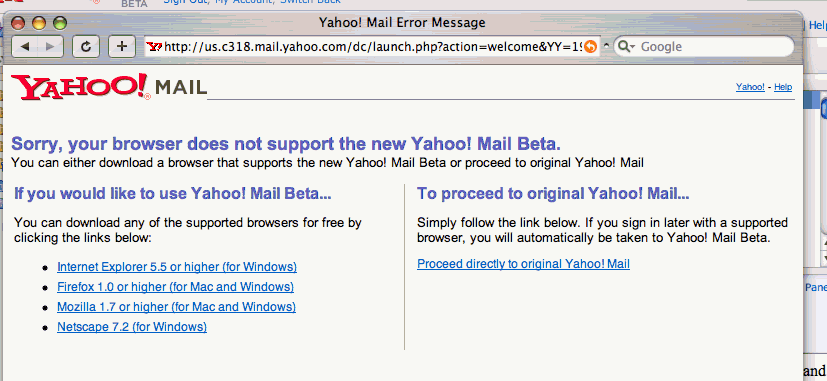
Postscript: Yahoo Mail works with Firefox on the Mac, but it does not work with Safari.
# Posted by Dave Winer on 9/14/05; 5:51:17 PM - --
The Israelis have found the way to fight the War On Terror, and it's pretty clear the British are tuning in, but we aren't here in North America, not yet, but we will, I hope.
First, I don't think that War On Terror is the right term, any more than World War II was the War On Submarines or the War On Airplanes. It is a war, though, for sure, between a Muslim militia that's distributed, and us. And how we define ourselves very much explains how we fight them, which we have to do. No choice about that.
Fighting the war using centralized force isn't going to work, as we've seen in London this week. Those bombs could have gone off, despite the fact that they're striking in exactly the same way they did just two weeks ago. It's as if some part of the World Trade Center was left standing after 9/11, and they were able to go right back and do it again, just two weeks later.
Can't turn to government to fight this war. They're going to do what governments do, try to perpetuate themselves. They're going to do things the same way they've "always" done them, and those ways don't work against distributed militias. Now the question is -- do the people have the will, or are we ready to be picked off while riding the subway or working in office buildings, or sitting in coffee shops, or even in our own homes? New York and London are on their way to becoming Baghdad and Beirut. We can't afford to look away from those places, that's the Grapefruit League for what will be major league baseball, in your home town. Look around you, the problem is everywhere. How can you tell whose backpack contains a bomb? You can't. Now what.
The answer to a distributed war is distributed defense. Instead of hiding from people with brown skin, people who speak funny, who look like terrorists, we need to work with them, because (key point) most of them aren't terrorists, but they may come from communities that produce them. Do the communities have an inkling that there's a bomber in the house? On the block? Have we asked? What are the warning signs that a young person has turned? We need to study this, understand it, and then distribute the knowledge, actively, quickly.
I don't find reassurance in police commissioners talking on TV about new techniques of finding bombs on subways. We won't find enough of the bombs to alter our psychology. People stayed home for months after 9/11. The airports, restaurants and shopping malls were deserted. The economy really suffered. It will suffer again. Now, while we have a measure of sanity, we need to make being brown and talking strangely interesting and listen. We need to feel that we can solve the problem, that the deaths are not totally in vain, that we're getting better at preventing the bombing.
Rush Limbaugh and his idiots will want to fight this war with internment camps. Good luck. How big will the camps be? How will you feed the prisoners? And what comes next, when that doesn't work? Even the dittoheads won't want to go there, at least most of them won't.
Let's hope the families know when a kid turns into a bomber, and have the guts to turn him in. Let's get them on our side, acknowledge that they want life to get better, not turn to shit. That's what they're saying. Now, do we have the guts to listen?
# Posted by Dave Winer on 7/23/05; 7:33:15 AM - --
I got a response from Jimmy Wales to a note about Wikipedia on Scripting News on a private mail list. He may if he wants, make his response public. Imho, it was unnecessarily personal. But he showed me something about Wikipedia that I hadn't seen before. My first note wasn't really a bug report to Jimmy Wales, or a request for an investigation of the change history of any single article on Wikipedia, but I certainly understand why he might have intererpeted it that way. But now that he has responded, I feel the issue has grown a little larger, if only temporarily.
This is much like the discussions we had when we first met the advocates of open source. They, like Wales, maintained that they had cracked a large problem, a bug in human nature, they had found a way to create a hive that worked cooperatively in almost a utopian fashion to develop software for free that was perfectly tuned to human needs. People who didn't develop software, who were somewhat mystified and frustrated by the process of asking for features but never getting as much as a courteous response from the people they paid for software, hoped they could get better service from programmers who worked for free.
Why should working for free be the big difference, we puzzled. We were already working for free, and also giving away most of our source, but human nature hadn't changed in our world.
Well, it turns out it hadn't changed in theirs either -- most open source projects treated their users' check-ins as feature requests. Projects were pretty much as they were in the commercial world, or on Compuserve communities (dating back to the early 80s) or in communities we participated in in the 70s on Unix systems at universities, without the formality of open source, without license agreements. Basically programmers can be generous people, but to get a crafted user interface required the work of a single mind, or a very small group of people who worked really well together.
Enter Wikiipedia, making the same kind of claims about reference work that Eric Raymond and others made for open source in the mid-90s. It turns out it's as much snake oil as what ESR was selling. They hadn't cracked some basic code in human nature. People are still people, and they're going to produce biased work and there are gatekeepers, only power isn't expressed in money these days, it's in time.
The supposed technical methods they have to guarantee integrity fall down. You can see the results in a fairly technical area, where there really is very little doubt about the facts, all the people are alive, a researcher could, if he or she wanted to, build a pretty accurate picture. I read histories as a hobby, I'm not a historian, but I love history, I have since a child. These people are making a mockery of the process of doing research, much as the open source advocates were mocking the very serious art of developing clean, usable and reliable software, something I am an expert in, not as a hobby.
The result in software was a worsening of an already bad situation. We were making progress in the 80s on ease of use, on crafting user interfaces that really worked for people. A lot was lost that we should be getting back to, and maybe now that the hype for open source is completely over, we are getting back to work on these very important problems. There's real cause for hope. But please, let's not go through the same thing here. Wales is a promoter, clearly, selling his own kind of snake oil. He's really smooth, had me going there for a bit, until he made it personal. Then I was thinking here, no -- he's not trying to build a great reference work, he's hyping something. Not sure what his gain is, and frankly I don't care.
People have asked me off-list -- what should be done here? (I guess they don't want to get in Wales's cross-hairs as I have apparently.) There's nothing to do, I say, other than set expectatiosn realistically. Wikipedia is not a revolution. The concerns of librarians and professional researchers are valid. Let's not throw the baby out this time. This isn't about the promoters, because Wikipedia isn't something they control, they'll tell you that all the time, and it's true
# Posted by Dave Winer on 6/13/05; 4:06:07 AM - --
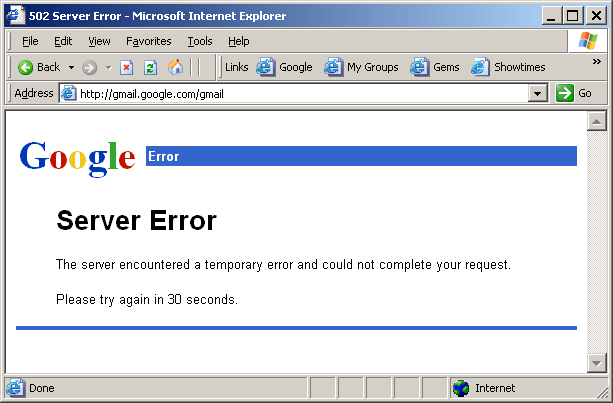
Where do you want to go today?
I want my Gmail like a baby wants its bottle.
Oh the hazards of centralized systems. :-(
# Posted by Dave Winer on 6/4/05; 4:31:32 PM - --
I read a theory on Doc Searls's blog that the reason you don't see many employee blogs from Apple and Google is that you don't need to blog when you're winning.
Today we see good reasons why both Apple and Google should be blogging.
For Apple, there's quite a bit of confusion on the blogs after their announcement last night of a podcasting client to be built into iTunes. As the designer of the functionality they're adding, I say this is a good move.
But the blogs are also carrying Jobs's offensive and misguided characterization of podcasts as the "Wayne's World of radio." He got it backwards. Wayne's World is fiction, podcasting is real. Of course a baby boomer who owns a movie studio is likely to see it this way. We were brought up on television, our thinking is rooted in the centralized monoculture of the 20th century.
Another key difference between Wayne's World and podcasting is that there was only one Wayne's World, there are thousands of podcasts, and there will be millions in the coming years. In fact, Apple has just helped cement that, along with their excellent audio tools that ship with the Mac OS.
So this could be a time for Apple people to be crowing, their non-existent bloggers could be answering questions, acting as their sales force, their barrier to entry, their answer to Bill Gates's sniffing that cell phones will soon usurp the position of iPods. Bill Gates understands something about truly large scale adoption of technology, and Gates lets his people blog. He's a smart businessperson for that.
On the same day, Tim Bray notes that the terms of use of AdSense for Feeds make no sense and wonders why he doesn't know who to contact, and why that person doesn't have a blog, in fact, why doesn't Google have any personal connect to the blogging world, as Scoble connects for Microsoft or Zawodny and Beattie for Yahoo (and Bray himself for Sun).
One has to wonder if Google really means to trample the web or are they just stumbling around, like the drunk elephant that IBM used to be, stamping out the little critters and getting ready for their own fall?
Both Apple and Google will soon be under assault, it seems certain, by larger competitors who have let their people blog. To think they can afford not to be present in the arena of the present (not just the future any more) is the kind of dangerous naivete bordering on hubris that could make them lose their competition, by default, by not even showing up.
Dave
PS: Worth noting that more than a few of the late innovations in the Mac OS came out of Dave Winer Labs. I know they won't thank me for it, but I also know they must appreciate it at some level.
# Posted by Dave Winer on 5/23/05; 6:45:49 AM - --
For what it's worth, and seriously, no joke -- I don't think Rogers should give benedictxvi.com to the Vatican.
I think the domain should be used for an independently-authored weblog about the policies and actions of the new Pope by someone who is expert in the papacy and independent of the Catholic Church.
What an opportunity to get serious visibility for weblogs as a source of news and perspective. Imho, it's not about heaven and hell, eternal damnation or Rogers's grandmother.
The church is a hugely powerful political, social and economic force, and its actions are controversial and deserve some visibility, and MSM isn't doing its job.
And for the new Pope, it's a chance to participate in history. It's the kind of thing you might imagine his predecessor really going for, until of course it got a story he didn't want them to get.
# Posted by Dave Winer on 4/21/05; 10:16:23 AM - --
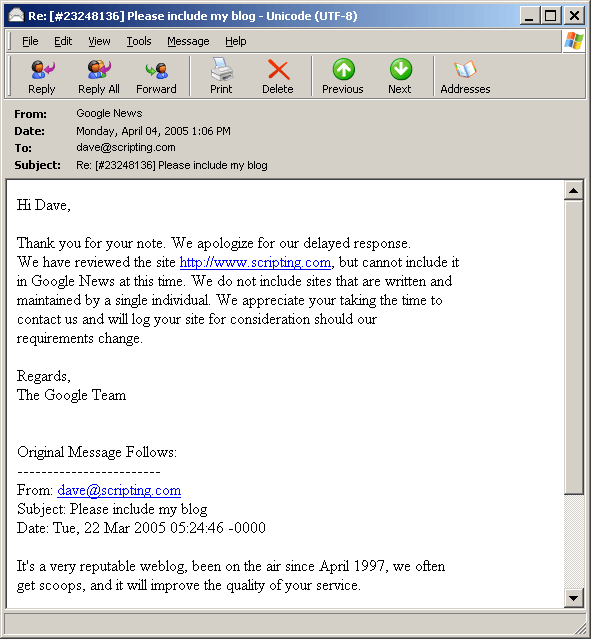
I applied to have Scripting News included in Google News, and just got the rejection notice. However it appears the decision was based on a misunderstanding.
Scripting News is not really written by an individual as they say. I link to articles written by lots of people. Today, for example, I link to stories written by Jeremy Zawodny, Soxaholix, Gizmodo, Don Park, Paolo Valdemarin and Megnut.
In this sense I am something between the editor of the front page of a news site, or a reporter writing an article. I have a bunch of freelancers and sources, with some original editorial stuff thrown in.
If they think the sites they include work any differently, well, I think they're mistaken.
Anyway, maybe they're just being polite. Maybe they don't like the stories I link to, maybe the quality isn't high enough to meet their standards. Of course I think it's pretty good, but then I'm biased.
# Posted by Dave Winer on 4/4/05; 1:34:32 PM - --
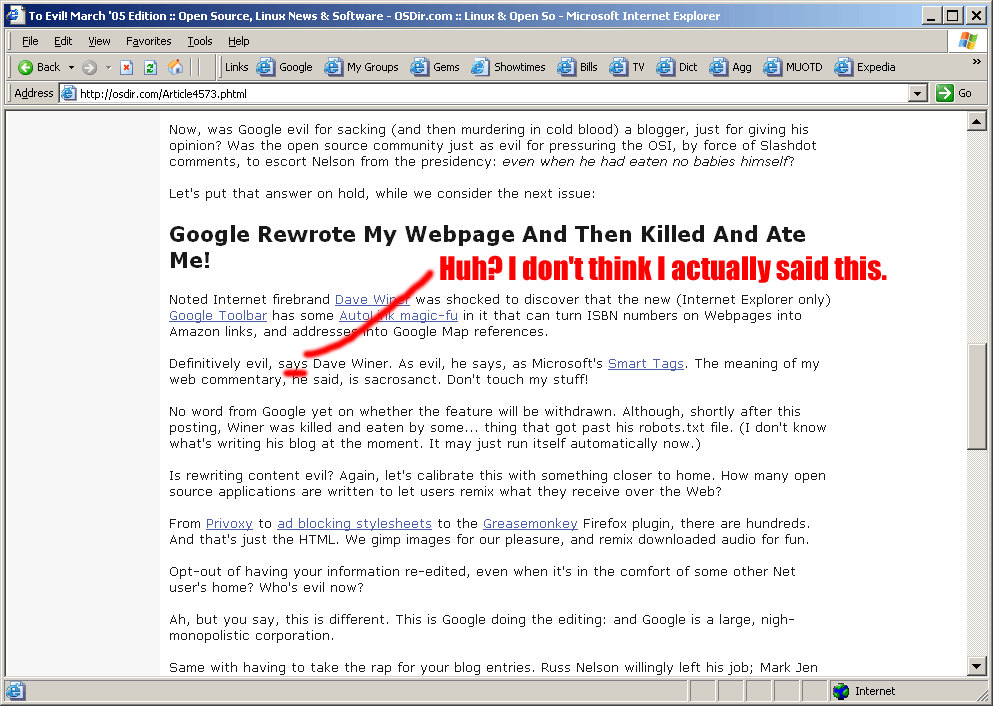
Danny O'Brien, writing on an O'Reilly site rants at and about me, and my position on Google's AutoLink. He quotes me saying things I'm quite sure I never said, and don't agree with, and then proceeds to make fun of me for saying these things that I didn't say, and he discredits the ideas behind the quotes, and not surprisingly he wins the argument -- that he's having with himself!
The irony is that the debate is about Google changing what people say. It's a serious subject. What if Google, like Netscape, sells out to a company that really knows how to churn a buck on the Net? Then our writing becomes a revenue source for them, without our permission, without them sharing the revenue.
Or suppose Google sells out to people who want to get a President elected that I don't support, and decides to rewrite my pages so it appears as if I do?
That's why it's so appropriate and ironic that O'Brian doesn't argue with what I actually said and has to put words in my mouth to win his argument. He's proven my point, and illustrated exactly why the web should convey meaning without interference from big companies, who may or may not be evil. (Frankly who cares.)
And why doesn't he point to the essay I wrote on this subject so his readers can decide for themselves, weigh the issues, and make up their own minds? This is what the web is about, to me at least. And if you're going to make fun of someone, at least throw a few shots at yourself and your friends. People see right through this kind of argument, they're a lot smarter than you give them credit for.
# Posted by Dave Winer on 3/18/05; 1:32:30 PM - --
1. We're seeking out commercial information all the time. When you look up a movie review, or choose a plane flight, shop for an apartment, pick a restaurant or review your stock portfolio, you are seeking commercial information. So, therefore, there's nothing particularly bad about commercials.
2. Most TV and radio commercials are ANNOYING. By design. They're forcing commercial information on you that you DON'T WANT. This is bad.
3. So instead, create commercial information, in any form you like and make it available. This is very different from sneaking it in, or being annoying. Make it available. Then you have a responsibility to be: Informative. Respectful. Entertaining. Wouldn't that be nice?
4. Sometimes commercials are all that. Then I don't skip over them on my TiVO, in fact, what I do is play them over and over on my TiVO. So all the new media does is change the rules. Instead of being intrusive assholes, be entertaining informers.
5. Unfortunately for people who are intrusive assholes, there's not much they can do. Hopefully they made a lot of money in the last century and can retire and be totally puzzled by the way things turned out.
# Posted by Dave Winer on 3/15/05; 2:50:35 PM - --
|