 As I go through porting Frontier, there's a sad note. What if Apple had made it a goal that Frontier move along with their OS. That it was a unique advantage of the Mac and should be promoted as such. Don't laugh, because Apple did do that for ThinkTank and MORE, a few years before. We spent a lot on advertising, but they spent a lot more advertising our product. We cross-licensed our tech, so everyone in my little company had a Mac. This was a Bill Campbell idea. I was having trouble convincing my board that the Mac was a good bet and they were all PC users. So we got them Macs too, for free, from Apple. And they site-licensed MORE, and you gotta know that really helped sales. They were hungy, and this is something today's tech industry only feels in the most crude way, as in "what can we steal" or "what can we lock down." If they had put a fraction of the commitment behind Frontier that they had for Hypercard, some very cool things could have happened. And maybe we could have made the two work together. Amazing, two contemporary scripting systems on a small platform, relatively, in an OS that was transitioning to IAC, didn't connect. They missed a lot of opportunities by being so employee centered. Their developers were willing to move mountains to make the Mac perform. Apple was defensive. And now I'm beginning to see more clearly how much was lost. #
The bottom line is that tech companies have rarely understood that developers can be major influencers. We give a platform new meaning. It's a good deal to invest in the people doing the work, who often are doing it for love more than money. That grew into the blogosphere. There was no telling where Frontier would take us, and it would have cost them so little to help insure it had a future, but the did the opposite.#
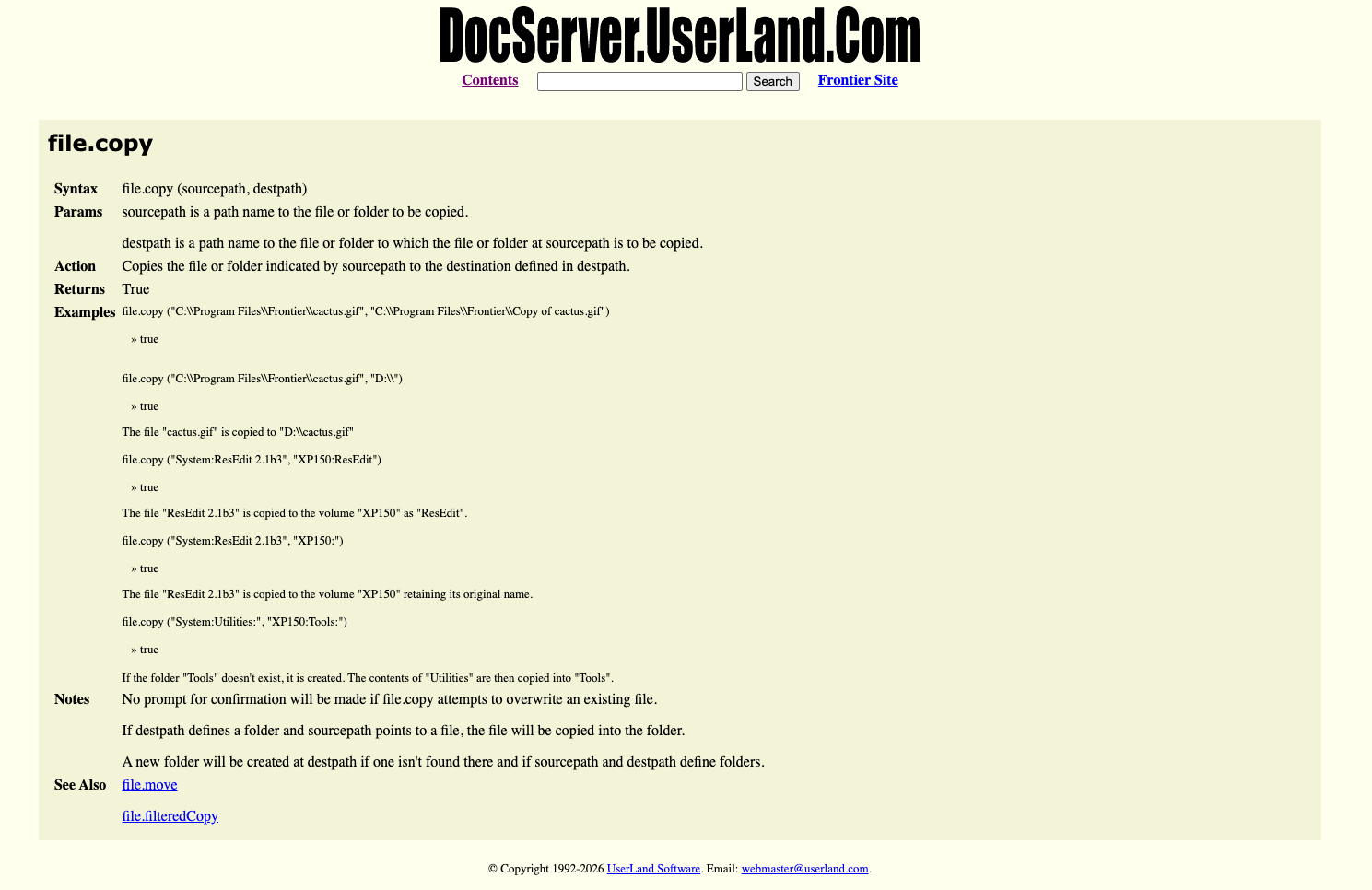
Milestone. We were able to get the DocServer site for Frontier to build. Here's the page for the file verbs. And within that group the page for file.copy. It worked the first time, but there were errors in the new kernel that were fixed. The site looks dated, of course -- it was created in the 90s. We will update the CSS to be more like the DocServer site for Drummer, which was done a couple of years ago. Almost everyone on the team contributed to this site, Wes Felter, Andre Radke, Jake Savin, Brent Simmons, and myself. I see there names a lot and it makes me happy to see this group effort preserved. #
Sometimes I forget how much fun I have making software tricks that people don't even notice but contribute to the "it thinks like I do" feeling a of crafted UI. I think of it like walking on the Highline in NYC. You're just walking, right? But you're above it, in a city where a lot of what's going on is above you. And it's comfortable. Why? You don't need to know, it just is. But someone made it that way.#
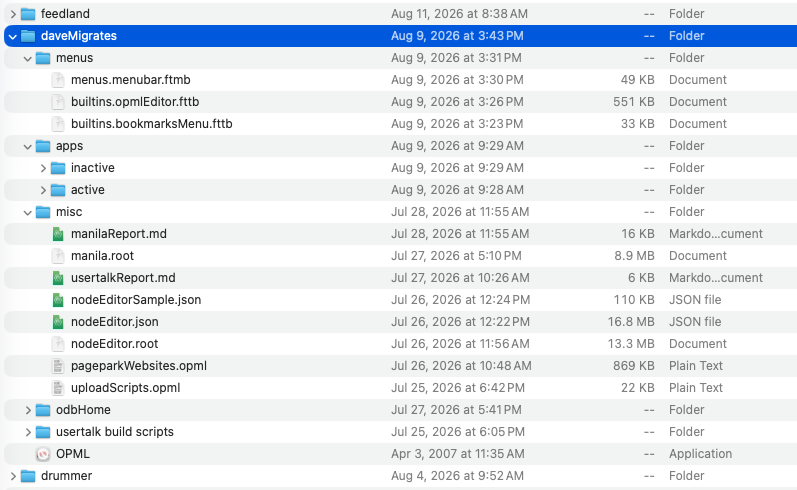
- When I started the Atlantis project, a port of UserLand Frontier to modern system, I had a goal in mind that has been achieved. It was part of a project I named daveMigrates. The goal was to use new hardware and system software to do the work I was doing in Frontier. #
- At first we got a portion of Frontier working, planning to use Electric Drummer as the UI. It took about five minutes to realize that would mean reimplementing most of what's in Frontier in a new way in Drummer's UI which is very different from Frontier's. I could see that porting the whole thing would be faster, so that's how we proceeded. #
- Now, there are lots of bugs and some big features missing, but it actually does all that Frontier does that I need for my work, which I have proven by doing the work. A lot of the verbs haven't been ported but they won't be -- they're no longer relevant in the world of 2026. And there are new verbs for Markdown, and kernelized verbs for JSON. The core verbs have been ported. We've been gradually working on getting Manila to run, it's probably the most complex piece of software that was ever written in Frontier, at least by UserLand. But we can compile and run the DocServer app, which is itself quite large and written in a different style from how we work now. All the work in Manila was why we got so far with DocServer so quickly. #
- Why this is a personal note -- I'm pretty sure the goal of daveMigrates has been achieved. To the extent that's true, all work beyond this point is for my love of Frontier, basically my life's work and why we were able to move so fast in the early days of the web. I want there to be a good record of what it does and how it works, and it to serve as prior art to future developers my friend Claude (who now probably has a more complete picture of how Frontier works than any human and I am glad of that, unlike other creative people who dream of getting paid for stuff that people aren't paying for). #
- We will release the source, and it will be available as a download, and we will port the support parts, and I'll stay with it as long as it makes sense and I have the time and good health. #
- Whether it advances beyond that involves a lot of factors. I really want to get back on course with RSS.chat and FeedLand asap. These two products were designed to be connected, one for writing, the other for reading, and to take it far beyond the blogging paradigm that was pushed aside by Twitter et al in 2006. I wrote about this on Friday in the continued dialog with Toni Schneider. He wrote in his product, Bluesky, and I wrote in my product RSS.chat. And that is right, and they should work much better with each other. Choice everywhere is the foundation of the web. The tech industry has tried to undermine that, and generally has succeeded but I have not given up. 😄#
- In the web that I envision, it wouldn't matter where each of us wrote, we could also read where we want to read. Small parts loosely joined. All parts replaceable. A lot of things have to happen to get there, but I'm going to put out a demo of what I have in mind. It's far from impossible, we already have the core technology to create the bridge. It's called RSS 2.0 with a few new elements. #
- See RSS as a social network for a technical walkthrough.#
- It may sound futuristic, but it really isn't. We did wonderful things for MP3s with podcasting, all I want now is to do the same for text. All we need there is a standard for text that's as strong as the one for sound, MP3. And for that we have two excellent places to start -- Markdown and RSS 2.0. As we used to say in ye olde school blogosphere -- bing!#